Content Decay: How to Spot It and Win Back Lost Rankings
Content Decay Explained: Why Rankings Drop and How to Spot the Signs
If you’ve noticed a once high-performing blog post slowly losing traffic, you may be facing what’s known as content decay. This isn’t an overnight drop but a steady decline in rankings, impressions, and user engagement over time.
Content decay is a natural part of digital publishing because search trends evolve, competitors release fresher material, and search engines adapt their algorithms. The majority of content published online eventually loses visibility unless it is regularly maintained, which makes long-term performance a challenge for many site owners.
The good news is that content decay is not permanent. Unlike completely outdated articles, decayed content usually has a strong foundation and can often be revived with the right updates and optimisation.
In this guide, you’ll learn exactly what content decay is, why it happens, how to spot it early, and—most importantly—the strategies you can use to recover lost rankings and traffic.
What Is Content Decay (and What It Isn’t)
Core Indicators of Content Decay
Content decay is best described as a slow decline in organic performance rather than a sudden drop. The first sign is usually a gradual fall in website traffic to a particular page. This is often paired with slipping keyword rankings, where content that once sat comfortably in the top positions starts to slide further down the search results.
Another clear indicator is a reduction in impressions and click-through rate (CTR). Even if the page still appears in search results, fewer users are engaging with it, signalling that it no longer matches their expectations or intent.
Why It’s Not Just “Old Content”
It’s important to understand that content decay is not the same as content being old. Some evergreen pages continue to perform strongly for years without losing their value.
The real difference lies in relevance and freshness. When information becomes outdated, examples no longer resonate, or competitors provide more comprehensive answers, even strong pages can begin to decay.
Main Causes of Content Decay
Shifts in Search Intent and User Behaviour
One of the biggest drivers of content decay is a change in how people search. Search intent can evolve quickly—what users wanted two years ago may no longer match today’s needs. For example, an informational query may shift into a commercial one, leaving older content misaligned with user expectations.
When behaviour changes, even high-quality content may struggle to stay relevant in search results.
Competitor Improvements
The digital landscape never stands still. Competitors continually publish updated, more comprehensive, and engaging content. They might include richer media such as videos or infographics, giving them an edge in both rankings and user engagement. This makes once strong content less competitive over time.
Algorithm Updates and SERP Changes
Search engines frequently update their algorithms to refine ranking factors. These changes often prioritise freshness, expertise, and user experience. At the same time, new SERP features like featured snippets, local packs, or AI-powered overviews can push traditional results further down the page, reducing visibility.
Internal Issues Within Your Site
Sometimes the cause is closer to home. Keyword cannibalisation, where multiple pages target the same topic, can dilute ranking power. Outdated internal links or old statistics can also weaken authority. If these issues aren’t addressed, even strong pages risk slipping into decay.
How to Spot Content Decay
Key Metrics to Monitor
The first step in identifying content decay is tracking performance metrics over time. A steady drop in organic traffic to a specific page is often the earliest warning sign. Rankings should also be checked regularly, as a slide from the top three results to the second or third page can cause a dramatic traffic loss.
Lower click-through rates (CTR) and shorter dwell times are equally important signals, showing that even if users are finding your page, they may not be engaging with it as much as they once did.
Tools and Methods for Detection
Reliable tools make spotting decay far easier:
- Google Search Console for queries, impressions, and traffic patterns.
- Advanced SEO platforms such as SEMrush or Ubersuggest for detailed ranking trends and competitor comparisons.
- WordPress SEO plugins for quick visibility into underperforming pages.
Prioritising Which Pages to Fix
Not all pages deserve equal attention. Focus first on high-value content—those that once drove strong traffic or conversions but are now slipping. Pages with real business impact should always take priority over posts with little or no measurable benefit.
Winning Back Lost Rankings
Audit First
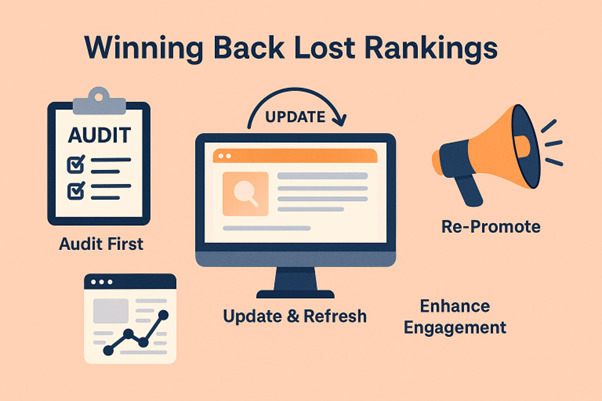
Every recovery plan begins with a thorough audit. Analyse each underperforming page to identify outdated sections, missing information, or broken links. Technical checks such as slow load times or poor mobile performance should also be addressed, as these factors directly affect visibility and engagement.
Update and Refresh
Once gaps are identified, refresh the content with the latest data, examples, and insights. Improve readability by refining headings, shortening long paragraphs, and making the content easier to scan. On-page optimisation—updating titles, meta descriptions, and image alt tags—can also give rankings a measurable boost.
Enhance Engagement
Modern search algorithms reward pages that keep users engaged. Adding visuals such as infographics or videos, inserting a clear FAQ section, and strengthening internal linking helps to increase dwell time and user satisfaction. Structured data can also expand your visibility through rich results.
Consolidate or Prune
If multiple pages cover similar ground, merge them into a single comprehensive piece. Content with no business value should be removed and redirected to preserve site authority.
Re-Promote
Finally, don’t let refreshed content sit unnoticed. Reshare it across social channels, include it in newsletters, and encourage new backlinks to strengthen its position in search results.
Preventing Future Decay
Regular Content Audits and Refresh Cycles
The best way to prevent content decay is to stay ahead of it. Schedule regular audits—ideally every 6 to 12 months—for key pages. During these reviews, check for outdated statistics, broken links, or shifts in search demand. Refreshing content regularly ensures it stays relevant and competitive.
Monitor SERPs for Evolving Intent and Competitors
Search intent is never static. What users look for today may be different tomorrow. By keeping an eye on search engine results pages (SERPs), you can identify when intent changes or when competitors introduce stronger, more detailed content. Adapting early allows you to hold onto rankings before they slide.
Maintain Clean Site Architecture
Internal problems often fuel decay. Avoid keyword cannibalisation by assigning clear targets for each page. Strengthen internal linking to distribute authority, and remove thin or duplicate content that clutters your site. A streamlined structure makes it easier for search engines to reward your most important pages.
Use Alerts and Dashboards
Setting up alerts and dashboards is a best practice that helps you react quickly if performance drops. Early detection of traffic declines gives you time to act before content loses significant visibility.
Want to Increase Your Organic Traffic & Get More Leads?
Conclusion
Content decay is an inevitable challenge for any website, but it doesn’t have to mean permanent loss. When you understand the signs—slipping rankings, falling traffic, and weaker engagement—you can take action before a page loses its value entirely.
The most effective approach is to treat content as a living asset. Regular audits, refreshes, and updates ensure your pages stay aligned with user needs and search engine expectations. By monitoring search intent shifts, keeping an eye on competitors, and maintaining a clean site structure, you build a foundation that can resist decay over the long term.
Equally important is recognising that recovery is often faster than starting from scratch. A refreshed page with strong authority can bounce back quickly, regaining visibility and conversions.
In the end, staying proactive is the key. Protect your content, monitor its performance, and commit to continuous optimisation to secure lasting rankings.
YOU DESERVE THE BEST
Work With Top-Rated SEO Company In Singapore
Let Us Help You Optimize Your Site Today
Frequently Asked Questions (FAQs)
Q: How often should I check for content decay?
A. It’s best to review your key content every 6 to 12 months, but high-traffic or business-critical pages may require quarterly checks.
Q: Can new content also suffer from decay?
A. Yes. Even new content can lose traction if it doesn’t match evolving search intent or if competitors publish stronger material soon after.
Q: Is deleting old content always a good idea?
A. Not necessarily. If content has potential value, it’s better to update and optimise it. Deletion should be a last resort for irrelevant or duplicate pages.
Q: What tools are most effective for spotting decay?
A. Google Search Console is excellent for tracking impressions and clicks. Complement this with SEO platforms such as SEMrush or Ubersuggest for deeper insights.
Q: How long does it take to recover rankings after fixing content decay?
A. Recovery times vary depending on competition and updates made. Many pages show improvements within weeks, while more competitive niches may take several months.
Get A Proposal
In a hurry? Just Give us a call or WhatsApp us at (65) 9385-8095
Stay In Touch
Call/Whatsapp us at (65) 9385-8095 or you may request for a callback.
Our Office Hours:
Monday – Friday: 9am to 6pm
We are closed on Saturday, Sunday and Public Holidays.