Page Speed in 2026: Why Website Performance Still Drives Rankings, Conversions, and Trust
Why Page Speed Matters More Than Ever in 2026
Website speed has transformed from a technical checkbox into a powerful business driver that shapes how users behave, how search engines rank, and how brands are perceived in 2026. Today, performance is directly tied to outcomes — from visibility in search results to actual revenue generated on your website.
Users are now less patient than ever. Around 47% expect a page to load in under 2 seconds, and over 50% will leave if it takes longer than 3 seconds, especially on mobile devices.
This shift in behaviour means even small delays carry real consequences. A 1-second delay can reduce conversions by around 7%, while faster pages can achieve significantly higher conversion rates when loading almost instantly.
Search engines have also evolved alongside user expectations. Google now prioritises real user experience through Core Web Vitals, making performance a measurable ranking factor rather than a theoretical one.
In simple terms, speed is no longer just about loading time. It is about delivering a seamless experience that builds trust, improves engagement, and drives measurable business growth.
The Role of Page Speed in Modern SEO
Performance as a Ranking Signal
Search engines now treat performance as a measurable part of user experience, not just a technical enhancement. Core Web Vitals — Largest Contentful Paint (LCP), Interaction to Next Paint (INP), and Cumulative Layout Shift (CLS) — set clear benchmarks for what a “good” experience looks like.
Google relies heavily on real-user data collected from actual visitors, meaning your rankings reflect how your site performs in the real world, not just in testing tools. This makes consistency across devices and networks critical for maintaining strong visibility.
Crawl Efficiency and Indexation
A faster website allows search engine bots to crawl more pages within the same time budget. When pages load quickly and render efficiently, it reduces crawl delays and improves how often your content is discovered and updated in search results.
This directly supports better index coverage and ensures new or updated pages are recognised faster. In contrast, slow-loading pages can limit crawl depth, leaving valuable content unseen and unranked.
Competitive Impact in SERPs
In highly competitive search results, speed often becomes the deciding factor between similar pages. When content quality and relevance are equal, faster websites tend to gain the edge in rankings and user engagement.
Even small delays can reduce click-through and interaction rates, which gradually weakens your position. Over time, slower websites lose visibility, while faster competitors capture more traffic and authority.
How Website Speed Directly Influences Conversions
Speed and User Decision-Making
When a page loads quickly, users move smoothly from interest to action without hesitation. Whether it is filling out a form or completing a purchase, fast performance removes friction and keeps the momentum going.
However, delays break that flow instantly. More than half of users abandon a page if it takes longer than 3 seconds to load, meaning every delay increases the risk of losing a ready-to-convert visitor.
Revenue Sensitivity to Load Time
Website speed has a direct and measurable impact on revenue. A delay of just 1 second can reduce conversions by around 7%, which quickly adds up for high-traffic websites.
Even improvements in milliseconds can lead to noticeable gains. Faster websites consistently outperform slower ones because users are more likely to complete actions when the experience feels effortless and responsive.
Performance Across the Funnel
Speed plays a different role at each stage of the customer journey. On landing pages, it shapes the first impression and determines whether users stay or leave.
On product or service pages, it builds confidence and allows users to explore without frustration. During checkout or form submissions, speed becomes critical, as any delay at this stage can lead to abandoned transactions and lost revenue.
Website Speed and User Trust

Perception of Quality and Reliability
Website speed plays a powerful role in how users judge your brand within seconds of landing on your page. A fast-loading website immediately feels polished, modern, and reliable, which builds confidence before any content is even read.
Users form an impression of a website in under a second, and performance is a key part of that judgement. When pages load instantly, it signals that the business is professional and capable of delivering a smooth experience.
Behavioural Response to Slow Experiences
On the other hand, slow websites create doubt almost instantly. Users often associate delays with poor quality or inefficiency, especially when interacting with forms or important pages.
This perception directly affects behaviour. Frustrated users are more likely to leave early, engage less with content, and avoid returning in the future.
Key Performance Metrics That Matter in 2026
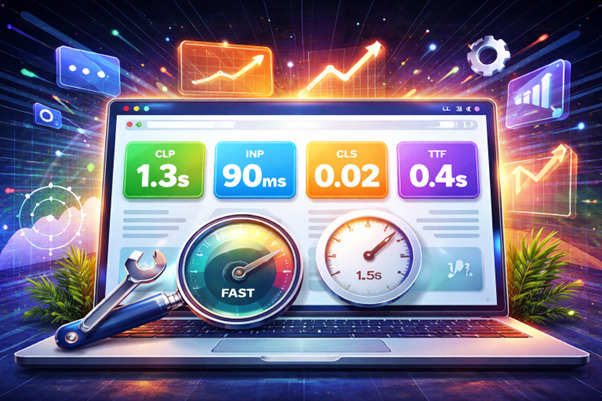
Core Web Vitals
Core Web Vitals are now the foundation of measuring real user experience. Largest Contentful Paint (LCP) tracks how quickly the main content loads, with a good target being within 2.5 seconds.
Interaction to Next Paint (INP) measures responsiveness when users interact, while Cumulative Layout Shift (CLS) ensures visual stability by preventing unexpected layout movements.
Technical Performance Indicators
Behind the scenes, technical metrics provide deeper insight into performance. Time to First Byte (TTFB) shows how quickly your server responds, which is critical for initial loading speed.
First Contentful Paint (FCP) measures when users first see content, while Total Blocking Time (TBT) highlights delays caused by heavy scripts.
Business Performance Metrics
Technical performance must connect to real business results. Conversion rate reflects how effectively your site turns visitors into customers, while bounce rate shows how many users leave without engaging.
Session duration reveals how long users stay and interact with your content.
Benchmarks for High-Performing Websites
Load Time Targets
In 2026, high-performing websites are expected to load quickly and consistently. The ideal benchmark is under 2 seconds, where engagement remains strong.
Once load time crosses the 3-second mark, abandonment rates increase sharply, especially for mobile users.
Performance Expectations
Performance is not limited to a single device. Mobile performance must match or exceed desktop standards, as most users now browse on mobile.
Consistency across regions, devices, and network conditions is critical for maintaining a stable user experience.
Advanced Optimisation Strategies for 2026
Front-End Efficiency
Modern optimisation starts with efficient content delivery. Using WebP or AVIF images can significantly reduce file sizes without affecting quality.
Lazy loading ensures elements load only when needed, while prioritising critical content improves perceived speed.
Infrastructure and Delivery
A strong infrastructure is essential. High-performance hosting improves server response times, while CDNs reduce latency by serving content closer to users.
Caching and edge delivery further enhance performance by reducing repeated processing and speeding up content delivery.
Code and Script Management
Efficient code improves loading performance. Removing unused JavaScript reduces page weight and improves speed.
Deferring non-critical scripts and limiting third-party tools prevents unnecessary delays.
Common Performance Pitfalls
Over-reliance on Heavy Media and Plugins
Large media files and excessive plugins can significantly slow down a website. Many plugins add hidden scripts that continue to impact performance over time.
Treat engagement as an outcome
Click-through rate and engagement reflect success rather than act as ranking levers. Human titles are most effective when relevance and trust are already strong.
Ignoring Mobile and Network Variability
Users access websites under different conditions. Failing to optimise for slower networks or mobile devices leads to inconsistent experiences.
Focusing Only on Scores Instead of Real Experience
High testing scores do not always reflect real-world performance. What matters is how quickly users can interact with your website.
Treating Optimisation as a One-Time Task
Performance requires continuous monitoring. Without regular updates, websites can gradually become slower as new content and features are added.
Why Page Speed Remains a Long-Term Growth Driver
Alignment Across SEO, UX, and CRO
Page speed connects SEO, user experience, and conversions. A fast website improves discoverability, usability, and action rates at the same time.
Compounding Business Impact
Faster websites drive better engagement, which leads to stronger long-term results. These improvements build over time, creating sustained growth.
Readiness for Future Search Trends
Speed prepares websites for AI-driven search and real-time experiences. Faster websites are easier for systems to process and deliver to users.
Want to Increase Your Organic Traffic & Get More Leads?
Conclusion
Page speed in 2026 is no longer just a technical metric hidden behind development tools. It plays a direct role in how your website performs across search visibility, user experience, and business results.
A fast website creates a smoother journey for users, reduces friction at every step, and supports stronger engagement from the very first interaction. When performance is prioritised, it becomes easier to guide users towards meaningful actions without interruptions.
At the same time, search engines continue to reward websites that deliver consistent and reliable experiences. This means speed is not just about improving load time, but about meeting the expectations of both users and modern search systems.
The key takeaway is simple. Website performance should be treated as an ongoing strategy rather than a one-time fix.
By continuously optimising speed, monitoring real user behaviour, and adapting to evolving standards, businesses can build websites that not only rank well but also convert effectively and earn long-term trust.
YOU DESERVE THE BEST
Work With Top-Rated SEO Company In Singapore
Let Us Help You Optimize Your Site Today
Frequently Asked Questions (FAQs)
Q: What is considered a good page speed in 2026?
A. A good page speed is typically under 2 seconds, with Core Web Vitals meeting recommended thresholds for user experience.
Q: Does page speed still affect SEO rankings?
A. Yes, page speed remains a confirmed ranking factor and influences how search engines evaluate user experience.
Q: How does website speed impact conversions?
A. Faster websites reduce friction and increase the likelihood of users completing actions like purchases or enquiries.
Q: What are the most important website speed metrics to track?
A. Core Web Vitals such as LCP, INP, and CLS, along with supporting metrics like TTFB and FCP.
Q: What is the fastest way to improve website performance?
A. Optimising images, enabling caching, reducing scripts, and using a CDN are some of the quickest ways to improve speed.
Get A Proposal
In a hurry? Just Give us a call or WhatsApp us at (65) 9385-8095
Stay In Touch
Call/Whatsapp us at (65) 9385-8095 or you may request for a callback.
Our Office Hours:
Monday – Friday: 9am to 6pm
We are closed on Saturday, Sunday and Public Holidays.