
Building SEO-Ready Websites from Day One: A Developer’s Checklist
How to Build an SEO-Optimised Website from the Start
Building an SEO-ready website from the ground up is no longer optional — it’s a necessity if you want to compete in search results from day one. Search engines process billions of queries daily, and your site’s visibility depends on how well it’s structured, coded, and optimised before it ever goes live.
By embedding SEO principles into your development process, you avoid costly retrofits later and give your site a competitive head start. This means planning content around real search demand, creating a logical site architecture that’s easy for both users and search engines to navigate, and ensuring technical settings like sitemaps, robots.txt, and HTTPS are correctly in place.
Even small oversights at the build stage can affect how your site is crawled, indexed, and ranked. Treating SEO as part of development — not an afterthought — ensures your website is search-friendly from the very first click.
Pre-Build Planning
Conduct targeted keyword research and map terms to planned pages
Before a single line of code is written, identify the keywords your target audience is actually searching for. Focus on terms that have both healthy search volume and strong intent, ensuring each one aligns with your business goals.
Once identified, map these keywords to specific pages in your site plan. This ensures every page has a clear search purpose and prevents keyword cannibalisation, where multiple pages compete for the same query.
Define logical site architecture with a clear navigation hierarchy
Organise your content into a logical hierarchy, starting with broad categories at the top and narrowing into more specific pages below. A well-structured navigation allows users to find what they need quickly and enables search engines to understand the relationships between pages.
Keep the depth shallow — ideally, important pages should be no more than three clicks from the homepage.
Plan URL structures for readability and relevance
Your URLs should be clean, descriptive, and keyword-friendly. Avoid unnecessary parameters or random strings, and use hyphens to separate words. A well-crafted URL not only improves click-through rates but also sends clear signals to search engines about page content.
Technical Setup
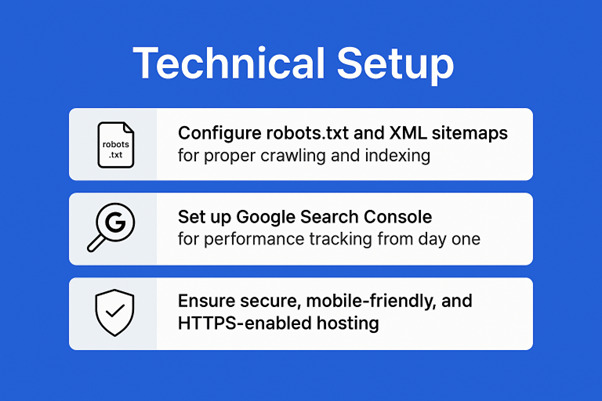
Configure robots.txt and XML sitemaps for proper crawling and indexing
A well-configured robots.txt file guides search engine crawlers, telling them which areas of your site to explore and which to ignore. This prevents wasted crawl budget on irrelevant or duplicate content.
An XML sitemap acts as a roadmap for search engines, listing your most important pages and helping them get discovered faster. Keep your sitemap updated automatically so new pages are indexed promptly.
Set up Google Search Console for performance tracking from day one
Connecting your site to Google Search Console early allows you to monitor indexing status, discover crawl errors, and see how your pages perform in search. You can also submit sitemaps, inspect URLs, and check for mobile usability issues — all crucial for a healthy launch.
Starting this tracking immediately gives you a baseline to measure growth over time.
Ensure secure, mobile-friendly, and HTTPS-enabled hosting
Choose hosting that offers strong uptime, fast load speeds, and HTTPS by default. A secure connection not only protects user data but is also a confirmed ranking factor.
Make sure your site is fully responsive, adapting seamlessly to any device. With mobile-first indexing now standard, this is critical for both user experience and search visibility.
Performance & Accessibility
Optimise Core Web Vitals: fast loading, stable layout, responsive interactions
Core Web Vitals are now key ranking signals, measuring how quickly your site loads, how visually stable it is, and how smoothly it responds to user actions. Aim for an LCP (Largest Contentful Paint) under 2.5 seconds, CLS (Cumulative Layout Shift) below 0.1, and INP (Interaction to Next Paint) under 200 milliseconds.
These metrics directly affect user satisfaction and can influence bounce rates and conversions.
Apply image compression, code minification, and caching strategies
Heavy images, bloated scripts, and unoptimised CSS can slow your site significantly. Use next-gen image formats like WebP, minify JavaScript and CSS, and implement browser caching so repeat visitors load your site almost instantly.
A lightweight, optimised site not only ranks better but also uses fewer server resources.
Ensure WCAG-compliant accessibility to meet user and search engine standards
An accessible site benefits everyone, including users with disabilities, and also improves SEO. Follow WCAG (Web Content Accessibility Guidelines) to ensure proper contrast ratios, alt text for images, and keyboard navigability.
Search engines reward content that’s accessible because it aligns with providing the best user experience possible.
On-Page Optimisation
Write concise, keyword-focused title tags and meta descriptions
Title tags remain one of the strongest on-page ranking signals. Keep them under 60 characters, place your primary keyword near the start, and ensure they accurately describe the page content.
Meta descriptions don’t directly impact rankings, but they influence click-through rates. Aim for around 150–160 characters, include target keywords naturally, and write them to encourage action.
Use structured headings (H1–H3) for clarity and semantic relevance
Headings help both users and search engines understand your content hierarchy. Use a single H1 per page for the main topic, then break down sections with H2s and further details under H3s.
Each heading should provide context, include relevant keywords, and maintain a logical flow.
Implement schema markup where applicable for enhanced search visibility
Schema markup adds structured data to your pages, enabling search engines to present rich results such as star ratings, event dates, or product prices.
Implement types relevant to your content — whether that’s articles, products, or local businesses — to stand out in search results and improve click-through rates.
Content Integration
Publish original, high-value content aligned with user intent
Content is the backbone of your website’s search performance. Every page should provide genuine value, answering specific questions or solving problems for your audience. This means creating unique, well-researched material that goes beyond surface-level information.
When you address user intent effectively, visitors stay longer, engage more, and are more likely to convert — all positive signals for search engines.
Embed keywords naturally and maintain topical depth without over-optimisation
Your keywords should fit seamlessly into the content without disrupting readability. Overstuffing them can harm both rankings and user experience, as search engines now prioritise natural language and contextual relevance.
Aim for topical depth by covering related subtopics, examples, and supporting details. This not only strengthens your authority on the subject but also increases your chances of ranking for long-tail queries.
Balancing clarity, keyword relevance, and comprehensive coverage will make your content stand out while keeping it search-friendly from the start.
Linking & Crawl Pathways
Establish meaningful internal linking to support discovery of key pages
Internal links act as signposts for both users and search engines, guiding them to your most important pages. A strong internal linking structure ensures that valuable content isn’t buried deep within the site but is easily discoverable from multiple entry points.
Linking strategically can also distribute link equity, helping less authoritative pages gain visibility by associating them with higher-value ones.
Use descriptive anchor text and ensure no broken or orphaned links
Anchor text should be clear, relevant, and descriptive of the page it leads to. Instead of vague terms like “click here”, use phrases that provide context, such as “view our pricing plans” or “learn about responsive web design”.
Regularly audit your site to remove broken links and identify orphaned pages — those with no internal links pointing to them. Orphaned content is often overlooked by crawlers, meaning it may never appear in search results.
By maintaining healthy, descriptive links, you improve user navigation and make it easier for search engines to crawl and index your content effectively.
Post-Launch Monitoring
Track indexing status, performance metrics, and user engagement
Once your website is live, the work doesn’t stop — in fact, it’s just beginning. Monitor your indexing status to confirm search engines are discovering and adding your pages to their databases. Keep a close eye on performance metrics such as impressions, click-through rates, and average position in search results.
User engagement data, including bounce rates, time on page, and conversion rates, reveals how effectively your site meets visitor expectations. These insights can highlight areas for both content and UX improvement.
Address technical errors promptly and refine optimisation based on data
Technical issues like broken links, slow-loading pages, or mobile display problems can harm rankings and drive visitors away. Set up regular site audits to detect and fix these problems quickly before they affect your visibility.
Use data to guide your optimisation strategy. Whether it’s improving underperforming content, refining internal linking, or enhancing page speed, decisions should be evidence-based. Continuous monitoring ensures your SEO remains proactive rather than reactive, keeping your site competitive in evolving search landscapes.
Want to Increase Your Organic Traffic & Get More Leads?
Conclusion
Launching a website is only the first step — ensuring it is SEO-ready from the start is what sets you apart in competitive search results. By integrating best practices into every stage of development, you create a site that is technically sound, user-friendly, and primed for visibility. From keyword mapping to structured data, each element plays a vital role in how search engines and visitors experience your content.
The difference between a site that thrives and one that struggles often comes down to preparation. Developers who prioritise SEO during the build phase avoid costly retrofits, improve indexing speed, and build a stronger foundation for long-term growth.
Now is the time to act. Apply this checklist, run regular audits, and track performance closely. The sooner you start, the sooner you’ll see your site climb the rankings — and stay there.
YOU DESERVE THE BEST
Work With Top-Rated SEO Company In Singapore
Let Us Help You Optimize Your Site Today
Frequently Asked Questions (FAQs)
Q: Why is it important to make a website SEO-ready before launch?
A. Making your website SEO-ready from the start ensures search engines can crawl, index, and understand your content immediately after launch. This improves visibility, reduces the need for costly post-launch fixes, and gives you a competitive edge in rankings.
Q: What are the key technical SEO steps before launching a website?
A. Essential technical SEO steps include configuring robots.txt, creating an XML sitemap, ensuring HTTPS security, setting up Google Search Console, and optimising for mobile devices and Core Web Vitals performance metrics.
Q: How does site architecture affect SEO?
A. A clear site architecture helps search engines understand page relationships and ensures important content is easily discoverable. Shallow navigation, logical categorisation, and optimised URLs all contribute to stronger rankings.
Q: What role does content play in building an SEO-ready website?
A. High-quality, original content aligned with user intent is crucial. It should be well-structured with natural keyword integration, topical depth, and clear headings to improve relevance and engagement.
Q: How often should I monitor my website after launch?
A. Post-launch monitoring should be ongoing. Check indexing status, performance metrics, and user engagement regularly, and fix technical issues immediately to maintain search visibility and site health.
Get A Proposal
In a hurry? Just Give us a call or WhatsApp us at (65) 9385-8095
Stay In Touch
Call/Whatsapp us at (65) 9385-8095 or you may request for a callback.
Our Office Hours:
Monday – Friday: 9am to 6pm
We are closed on Saturday, Sunday and Public Holidays.