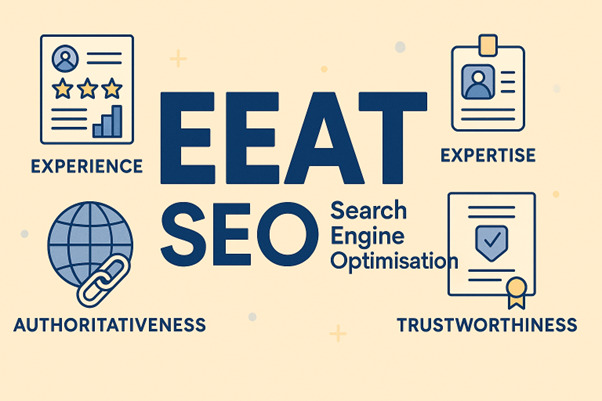
EEAT in Action: How to Build Trust Signals Across Your Website
EEAT in SEO: Why Trust Is the Real Ranking Power
In today’s search landscape, visibility is not just about keywords or backlinks – it’s about trust. Google evaluates content using the framework of EEAT: Experience, Expertise, Authoritativeness, and Trustworthiness. Of these four, trust is considered the most critical, as it underpins how people and search engines perceive your brand.
This matters more than ever, especially for sensitive topics that affect health, finance, or safety. Google refers to these as “Your Money or Your Life” pages, and here, credibility is non-negotiable. A lack of strong EEAT signals can mean lower visibility, reduced traffic, and lost customer confidence.
The good news? EEAT isn’t a ranking factor in itself. Instead, it’s a framework for demonstrating quality across your website. By embedding visible trust signals – from secure browsing to expert authorship – you create a digital presence that both users and algorithms recognise as reliable, credible, and worth ranking.
Why EEAT Matters
EEAT as a Guiding Framework
EEAT is not a ranking factor on its own. Instead, it is a framework Google uses to evaluate credibility and reliability. Quality raters assess whether content demonstrates trustworthiness, expertise, and accuracy, and their feedback helps improve Google’s algorithms.
This makes EEAT a guiding standard for producing content that resonates with users and aligns with what search engines aim to reward.
The Role of EEAT in High-Stakes Content
The importance of EEAT becomes most visible in what Google calls Your Money or Your Life (YMYL) topics. These are pages that can directly affect a person’s financial stability, health, safety, or overall well-being.
Here, accuracy and trust are essential. A poorly written guide on home décor may only frustrate readers, but misinformation on medical advice or financial decisions can cause real harm. That’s why Google applies stricter standards for YMYL queries, rewarding sites that display strong trust signals through EEAT.
Beyond YMYL Topics
EEAT is important across all niches, but its weight varies. For YMYL topics, Google holds content to the highest standards. For lifestyle or opinion-based content, EEAT still matters, but the evaluation is less rigorous. Ultimately, sites that consistently demonstrate EEAT tend to build stronger reputations, higher user satisfaction, and better visibility over time.
Demonstrating Experience

Why First-Hand Experience Matters
Google introduced the extra “E” for Experience to highlight the value of content created by those with real-world involvement. This could mean reviewing a product you’ve actually used, sharing lessons learned from a project, or describing the outcome of a client campaign. First-hand detail not only builds authenticity but also sets your content apart from generic articles that lack depth.
Readers are more likely to trust advice that feels lived and tested, and Google’s systems are designed to recognise that value.
Showcasing Your Involvement
There are several practical ways to highlight experience across your site. Case studies allow you to document challenges, processes, and measurable results, proving you’ve done the work before. Testimonials add credibility by letting satisfied customers speak on your behalf. Practical guides, written with specific steps or examples from your own experience, further reinforce that your knowledge is grounded in reality.
Even small touches, such as including photos, screenshots, or anecdotes, help validate that the content comes from real-world involvement.
From Generic to Authentic
Generic content may fill space, but it rarely convinces readers or search engines. Prioritising first-hand experience transforms your site into a trusted source. When visitors recognise genuine insights, they’re more likely to return, share, and convert — signals that search engines associate with quality and credibility.
Showcasing Expertise
Why Expertise is Essential
Expertise is one of the strongest signals Google looks for when judging content quality. It reflects not just what you know, but how well you can prove it. This is especially important for complex or sensitive subjects, where accuracy and authority carry significant weight.
When users see proof of expertise, they are more likely to trust your content and rely on your advice.
Highlighting Author Credentials
One of the simplest ways to showcase expertise is through detailed author bios. These should include qualifications, certifications, or professional experience that link directly to the content topic. A clear byline supported by a well-structured bio reassures readers that the person behind the article is credible and accountable.
Adding schema markup to author profiles strengthens this signal for search engines and enhances visibility in search results.
Reinforcing with Quality Content
Credentials alone are not enough. Expertise must be demonstrated in the content itself. This means publishing well-researched articles that draw on credible sources, reference up-to-date information, and provide actionable insights.
By combining specialist knowledge with clear, accessible writing, you not only strengthen user trust but also align with Google’s framework for reliable and expert-led content.
Building Authoritativeness

Why Authority Matters
Authoritativeness is about being recognised as a reliable source within your field. It goes beyond showing what you know and demonstrates that others acknowledge and value your voice. Search engines and users both look for external signals that prove your content is trusted across the wider web.
When your brand is consistently cited or mentioned by respected sources, it strengthens your authority in a measurable way.
Signals That Strengthen Recognition
Reputable backlinks, press mentions, and industry citations help demonstrate authority, but they are not guarantees of higher rankings. Instead, they act as supporting signals, showing that others view your content as credible. When combined with expertise and transparency on your site, these signals reinforce your reputation and trustworthiness.
Building a Consistent Presence
Authority is also about consistency. A strong brand presence across trusted platforms — from professional directories to social channels — reinforces your reputation. When users see your brand appear repeatedly in authoritative contexts, it builds familiarity and trust.
Maintaining this visibility is not just about ranking higher in search; it’s about positioning your brand as the go-to voice in your industry.
Establishing Trustworthiness
Why Trust Is the Foundation
Trust is the most important element of EEAT, and without it, even the most well-researched content will struggle to perform. Google evaluates whether your site feels safe, transparent, and reliable. Users do the same, and if they sense doubt, they will leave quickly.
Strong trust signals reassure both search engines and people that your brand deserves attention.
Site-Wide Trust Indicators
Simple technical steps can make a big difference. An SSL certificate is no longer optional — it shows your site is secure and protects user data. Clear and accessible policies, such as privacy statements or return guidelines, demonstrate that your business operates with integrity. Adding accurate and consistent contact details further confirms legitimacy, reducing user hesitation.
Transparency and Accuracy
Readers want to know who created the content and why they should trust it. Including bylines, citing credible sources, and being open about how content is produced adds transparency. Beyond that, content must be regularly updated and fact-checked. Outdated information signals neglect, while accurate and current pages signal responsibility.
Together, these practices form the backbone of digital trust, ensuring visitors feel confident engaging with your website.
Putting EEAT into Action
Clarifying Who, How, and Why
To fully apply EEAT, your website must make it clear who is behind the content, how it was produced, and why it exists. An informative About Us page, complete with author bios, is essential for building this clarity. Adding schema markup to author pages strengthens these signals for search engines, while editorial standards show visitors that accuracy and quality control are part of your process.
These steps transform your content from anonymous pages into trusted knowledge resources.
Balancing On-Site and Off-Site Signals
On-site elements are only half the picture. Reputation also depends on what others say about your brand. Collecting customer reviews, building digital PR, and engaging with your audience across trusted channels reinforce your authority beyond your own site. Consistency between on-site messaging and off-site recognition creates a powerful trust framework.
Standing Out with Originality
Search engines increasingly reward content that offers information gain — unique insights that go beyond repeating what’s already online. Publishing fresh research, first-hand case examples, or original methodologies ensures your content rises above “copycat” material. While this doesn’t guarantee rankings, it does increase your chances of being recognised as a credible and original source.
Want to Increase Your Organic Traffic & Get More Leads?
Conclusion
EEAT is not just a framework — it is the foundation of digital trust. By showing real experience, highlighting expertise, building authority, and prioritising transparency, your website becomes more than a collection of pages; it becomes a trusted destination for users and search engines alike.
The sites that succeed in today’s search landscape are those that treat EEAT as an ongoing commitment, not a one-off exercise. Every policy, every byline, every update, and every review is a chance to prove your credibility.
Start today by auditing your trust signals and asking one simple question: would users feel confident acting on this content? If the answer is yes, you’re on the path to stronger visibility, lasting reputation, and loyal audiences.
YOU DESERVE THE BEST
Work With Top-Rated SEO Company In Singapore
Let Us Help You Optimize Your Site Today
Frequently Asked Questions (FAQs)
Q: What does EEAT mean in SEO?
A. EEAT stands for Experience, Expertise, Authoritativeness, and Trustworthiness. It is Google’s framework for evaluating whether content is reliable and created by a credible source.
Q: Is EEAT a ranking factor?
A. No, EEAT is not a direct ranking factor. Instead, it guides Google’s quality raters and algorithms in assessing content credibility. Strong EEAT signals can improve trust and indirectly influence visibility in search results.
Q: Why is trust considered the most important part of EEAT?
A. Trust is the foundation of EEAT. Even if a website shows expertise or authority, it cannot succeed without being trustworthy. Factors like accurate information, secure browsing, and transparent policies all reinforce trust.
Q: How can I show experience on my website?
A. You can demonstrate experience by publishing case studies, reviews, testimonials, and practical guides based on first-hand involvement. This helps differentiate authentic content from generic or AI-generated material.
Q: Does EEAT apply only to YMYL topics?
A. EEAT is crucial for all websites, but it carries more weight in YMYL (Your Money or Your Life) topics like health, finance, and safety. Google applies stricter standards to this content to protect users from harmful misinformation.
Get A Proposal
In a hurry? Just Give us a call or WhatsApp us at (65) 9385-8095
Stay In Touch
Call/Whatsapp us at (65) 9385-8095 or you may request for a callback.
Our Office Hours:
Monday – Friday: 9am to 6pm
We are closed on Saturday, Sunday and Public Holidays.