How Google Search Ranking Works in 2026 (What’s Changed)
How Search Ranking Has Evolved by 2026
Understanding how Google Search ranking works in 2026 is no longer about chasing shortcuts or reacting to rumours about algorithm updates. It is about understanding how Google’s automated systems evaluate relevance, usefulness, and quality at scale.
Google processes hundreds of billions of pages using automated ranking systems designed to return the most relevant and helpful results as quickly as possible. These systems do not apply fixed rules. Instead, they evaluate each search individually, weighing many signals in real time.
Over time, Google has moved away from simple keyword matching toward understanding meaning, intent, and context. Crawling, indexing, and ranking still form the backbone of Search, but how content is evaluated within those stages has evolved significantly.
In 2026, strong SEO performance depends on how clearly a page satisfies user intent, how trustworthy it appears, and how easy it is to use. This article breaks down how modern ranking actually works, what has changed, and how to align your website strategy with how Google evaluates results today.
The 2026 Reality: Google Doesn’t “Rank Sites” — It Ranks Results
From blue links to a blended search experience
Google Search is no longer a simple list of web pages. A single results page can now include traditional listings, featured snippets, local results, videos, products, and AI-assisted summaries.
Because of this, ranking is no longer limited to owning a single position. Visibility is distributed across multiple result types, and success increasingly depends on whether your content is selected and surfaced across those different formats.
What Google actually evaluates at query time
Google does not assign permanent rankings to websites. Each search triggers an evaluation of eligible pages based on the query, context, and user settings.
Automated systems weigh relevance, usefulness, and other signals in milliseconds. The same page can appear prominently for one user and less visibly for another, depending on intent, location, and search history.
Why site-wide strength is not a guarantee
Strong site-wide signals help Google understand credibility, but they do not ensure visibility for every page. Ranking decisions are made primarily at the page level.
This means a well-focused, clearly written page can outperform a stronger domain if it better matches the user’s intent.
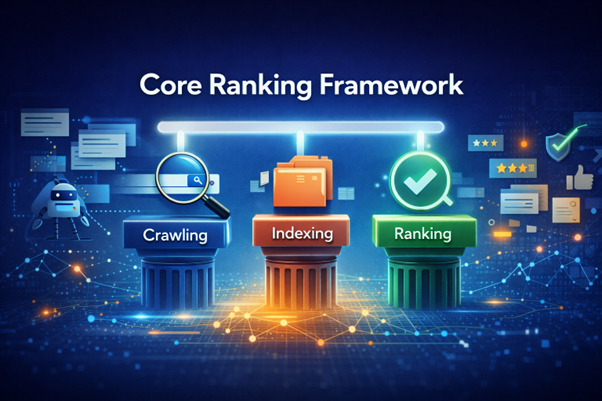
The End-to-End Pipeline: From Discovery to Ranking
Crawling: how content is discovered
Crawling is the entry point into Search. Google discovers most pages by following links, not through manual submission.
In 2026, internal linking remains critical. Clear navigation, logical page relationships, and stable URLs help crawlers reach important content efficiently.
Poor URL hygiene, broken links, and unnecessary duplication still waste crawl resources and slow down discovery.
Indexing: turning pages into retrievable entities
After discovery, Google processes pages for indexing. This involves rendering content and deciding what information is stored.
Pages may fail to be indexed if they cannot be rendered properly, are blocked, duplicate other content without clear canonicals, or offer little unique value.
Being indexed only means a page is eligible to appear. It does not mean it will rank.
Ranking: selecting and ordering results
Ranking happens only when a search is performed. Google evaluates indexed pages based on relevance to the query, content quality, usability, and contextual signals such as location and settings.
Many pages remain indexed but receive little visibility because they are outperformed at query time.
The Core Ranking Framework in 2026: Relevance, Quality, and Usability
Relevance: matching meaning, not just keywords
Keywords are still used as a basic signal, but repetition alone no longer works. Google evaluates whether a page covers the topic meaningfully and addresses related concepts users expect.
Aggregated and anonymised interaction data is used to improve how relevance is estimated over time, without relying on individual user behaviour.
Effective execution in 2026 focuses on intent clusters such as explanations, comparisons, and step-by-step guidance, supported by clear structure and headings.
Quality: prioritising what appears helpful and trustworthy
Once relevance is met, Google prioritises content that appears helpful. Signals associated with expertise, authoritativeness, and trustworthiness help shape this evaluation.
Link-based understanding still exists and helps Google interpret relationships between pages and topics.
Trust should be visible. Clear authorship, evidence of first-hand experience, sourcing where appropriate, and transparent editorial standards all support quality assessment.
Usability: when experience becomes the tie-breaker
When content quality is similar, usability can influence which result performs better.
Mobile friendliness, fast loading, stable layouts, and the absence of intrusive elements are now baseline expectations rather than advanced optimisations.
Context overlays: localisation and personalisation
Results vary based on location, language, device, and user settings. Google may also surface previously visited pages more prominently for the same user.
Because of this, rankings should be treated as directional indicators, not absolute positions.
Signals vs Systems: The Mental Model for 2026
Why Google emphasises ranking systems
Google describes ranking as the output of multiple automated systems working together. Each system evaluates different aspects of content using many signals.
Ranking primarily occurs at the page level. Site-wide signals help provide context, but they do not guarantee success or failure across an entire website.
This explains why individual pages must stand on their own merit.
Helpful content as a baseline requirement
Helpful content is no longer treated as a standalone update. Google has integrated people-first content principles into its core ranking systems.
This means helpfulness is a baseline quality expectation across a site, not a one-off optimisation effort.
Weaker sections, such as thin templates or low-value pages, may influence how overall site quality is understood, making consistency more important than isolated wins.
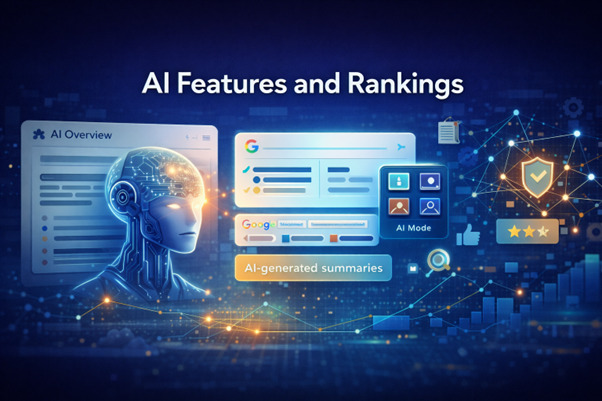
The Biggest Visible Change: AI Features and Rankings
AI Overviews and organic visibility
AI Overviews are part of modern Search experiences for certain types of queries. They provide summaries with links that allow users to explore content in more detail.
These features sit alongside traditional rankings and draw from pages Google already considers relevant and reliable.
In 2026, SEO execution benefits from being citation-worthy. Clear definitions, structured answers, and original insights improve the likelihood of being referenced.
Strengthening brand and entity signals also helps Google confidently attribute information.
What has not changed
Organic rankings are not influenced by advertising spend. Paid placements remain clearly labelled and separate from organic results.
Practical 2026 SEO Priorities
Build for meaning first
Topic-focused structures help Google understand content relationships. Entity-led hubs supported by intent-driven subpages remain effective.
Internal linking reinforces discovery and clarifies which pages matter most.
Make quality diagnosable
Quality should be easy to assess. Clear authorship, transparent editorial intent, and defined audiences reduce ambiguity.
Win the SERP features you can control
Clean architecture, appropriately structured data, and clear on-page content improve eligibility for enhanced result formats.
Treat engagement as an outcome
Click-through rate and engagement reflect success rather than act as ranking levers. Human titles are most effective when relevance and trust are already strong.
Want to Increase Your Organic Traffic & Get More Leads?
What Changed vs What Stayed the Same
The search presentation has changed significantly. AI-driven features, richer result layouts, and blended experiences now influence how and where users interact with search results.
Ranking has become more page-specific and intent-focused. Individual pages are evaluated on how clearly they satisfy a query, while helpfulness is treated as a baseline expectation across entire sites.
What has not changed is just as important. Crawling, indexing, and ranking remain the foundation of Search, and relevance is still the first requirement for visibility.
Quality, trust, and usability continue to separate strong results from average ones. Pages that are clear, credible, and easy to use consistently perform better over time.
The key lesson for 2026 is alignment. SEO success comes from applying proven fundamentals while adapting execution to a more complex, AI-enhanced search environment. Consistency, clarity, and genuine usefulness are no longer optional; they are the standard.
YOU DESERVE THE BEST
Work With Top-Rated SEO Company In Singapore
Let Us Help You Optimize Your Site Today
Frequently Asked Questions (FAQs)
Q: Does Google rank websites or individual pages in 2026?
A. Google primarily ranks individual pages, not entire websites.
While site-wide signals help Google understand overall context and credibility, ranking decisions are made at the page level based on how well a specific page matches a search query.
Q: Are keywords still important for Google Search ranking?
A. Yes, keywords are still important, but they act as a basic signal rather than a ranking shortcut.
Google now focuses more on whether a page covers the topic meaningfully and satisfies user intent, rather than how often keywords appear.
Q: What role do AI features play in Google Search rankings?
A. AI features, such as AI-generated summaries, sit alongside traditional search results.
They do not replace ranking systems, but rather draw from pages that Google already considers relevant, reliable, and useful, which makes content clarity and credibility more important than ever.
Q: Does being indexed guarantee that a page will rank?
A. No, indexing only makes a page eligible to appear in search results.
Ranking happens separately at query time, where Google compares indexed pages against others competing for the same search intent.
Q: Can paid ads improve organic rankings?
A. No, advertising does not influence organic rankings.
Paid listings are clearly labelled and operate independently from organic search results, which are ranked based on relevance, quality, and usability signals.
Get A Proposal
In a hurry? Just Give us a call or WhatsApp us at (65) 9385-8095
Stay In Touch
Call/Whatsapp us at (65) 9385-8095 or you may request for a callback.
Our Office Hours:
Monday – Friday: 9am to 6pm
We are closed on Saturday, Sunday and Public Holidays.